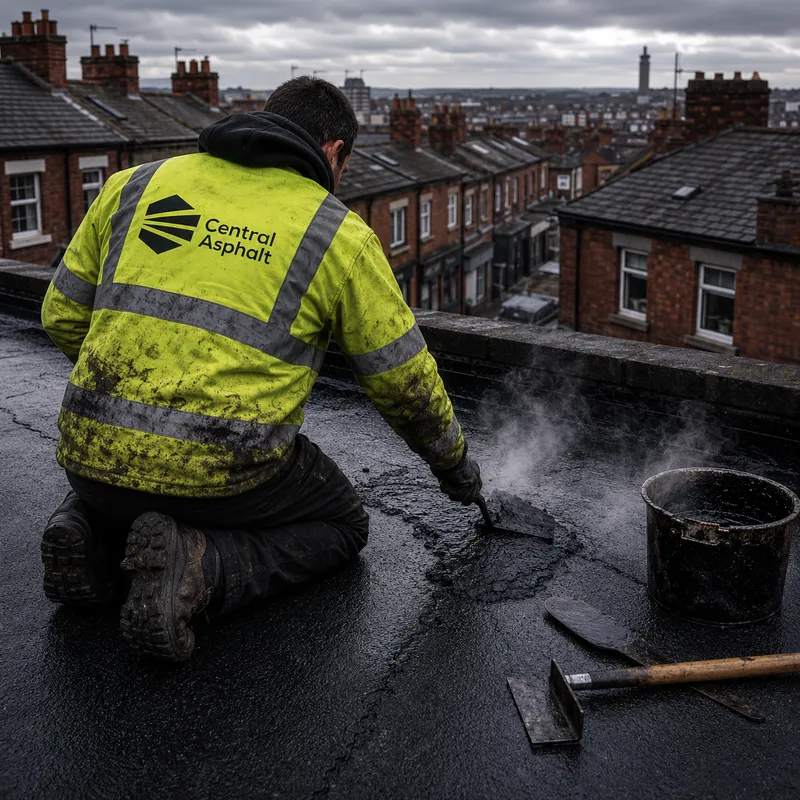
What Is Mastic Asphalt?
What is mastic asphalt? The one-paragraph answer
Mastic asphalt is a dense, hot-applied mixture of bitumen and finely graded limestone aggregate. It is heated to around 200°C, poured and spread by hand with a wooden float, and sets as it cools into a seamless, void-free, completely waterproof layer that is bonded to the surface beneath. Unlike the rolled asphalt (tarmac) used on roads, it contains no air voids, which is why it keeps water out. It has been used on British roofs, floors and basements for well over a century and is still specified today on buildings where failure is not an option.
How mastic asphalt is laid
For a flat roof, the deck is first covered with a loose-laid black sheathing felt, which lets the asphalt move independently of the structure. The asphalt is then laid in two coats to a total thickness of about 20mm, with upstands, skirtings and details around pipes, outlets and rooflights formed by hand while the material is hot. Because it is worked by hand, there are no seams, laps or fixings anywhere in the finished roof. It is usually finished with a solar reflective paint to protect it from UV and heat. Flooring and tanking are laid the same way, in grades chosen for the load the surface will carry.
How long does mastic asphalt last?
Properly laid mastic asphalt routinely lasts 50 to 60 years, and roofs much older than that are still in service across Liverpool. Because the material can be re-melted, worn or damaged areas are repaired by fusing new asphalt into the old rather than patching over it, so a well-maintained asphalt roof or floor rarely needs full replacement.
Where it is used
- Flat roofs on extensions, dormers, bay windows, garages, balconies, schools, flats and commercial buildings — see our roofing services.
- Flooring — seamless, damp-proof garage floors, whole ground floors, industrial floors and underlays for carpet, tile and wood — see flooring services.
- Tanking — waterproofing basements, cellars and lift pits against groundwater.
- Paving — car park decks, walkways, steps, playgrounds and tennis courts — see asphalt paving.
Mastic asphalt vs other flat roofing systems
Built-up felt is cheaper to install but is laid in sheets with overlapping, torched or bonded joints, and typically lasts 15 to 25 years. EPDM rubber and single ply membranes are light and quick to fit but are glued or mechanically fixed sheets with seams, and can be punctured. GRP (fibreglass) is seamless but rigid, and can crack with movement or poor installation. Mastic asphalt is heavier and takes more skill to lay, but it is seamless, bonded, tolerant of foot traffic, repairable by re-melting and has the longest proven service life of any of them. We install felt, single ply and liquid systems too, and will recommend whichever genuinely suits your roof.
Mastic asphalt vs tanking slurry and cavity drain membranes
Cement-based tanking slurries are brushed onto walls and rely on a perfect bond to a stable substrate; they can fail if the structure moves. Cavity drain membranes do not stop water but channel it to a sump and pump, which needs power and maintenance for life. Mastic asphalt tanking is a bonded, seamless barrier that stays flexible enough to cope with minor movement and needs no pumps.
Is mastic asphalt environmentally sound?
Mastic asphalt is made from naturally occurring bitumen and limestone, is inert once laid, can be reclaimed and recycled, and its very long life means fewer replacements and less waste over a building's lifetime.
Who should install it?
Laying mastic asphalt is a skilled trade: the material is handled at 200°C and every detail is formed by hand. Central Asphalt have been laying it in Liverpool, the Wirral and across the North West since 1989. If you are still asking "what is mastic asphalt going to cost for my roof, floor or basement?", get in touch or call Martin on 07860 432 729 for a free site visit and written quote.